
Foreigners Everywhere: Six Artists Reimagining Belonging at the 2024 Venice Biennale
At the 60th Venice Biennale, curator Adriano Pedrosa’s theme Foreigners Everywhere resonated across national pavilions and independent exhibitions with unusual clarity. Migration, identity, colonial legacies, and embodied memory converged into a kaleidoscope of artistic strategies—some intimate, some monumental, all insistently present.
Among the most compelling contributors were six artists who offered sharply distinct yet unexpectedly interconnected visions: Juvenal Ravelo, Karimah Ashadu, Santiago Yahuarcani, Ahmed Umar, Frieda Toranzo Jaeger and Jeffrey Gibson.
Together, they map a global terrain where colour, ritual, cosmology, and labour become tools not only for storytelling but for reclaiming agency.
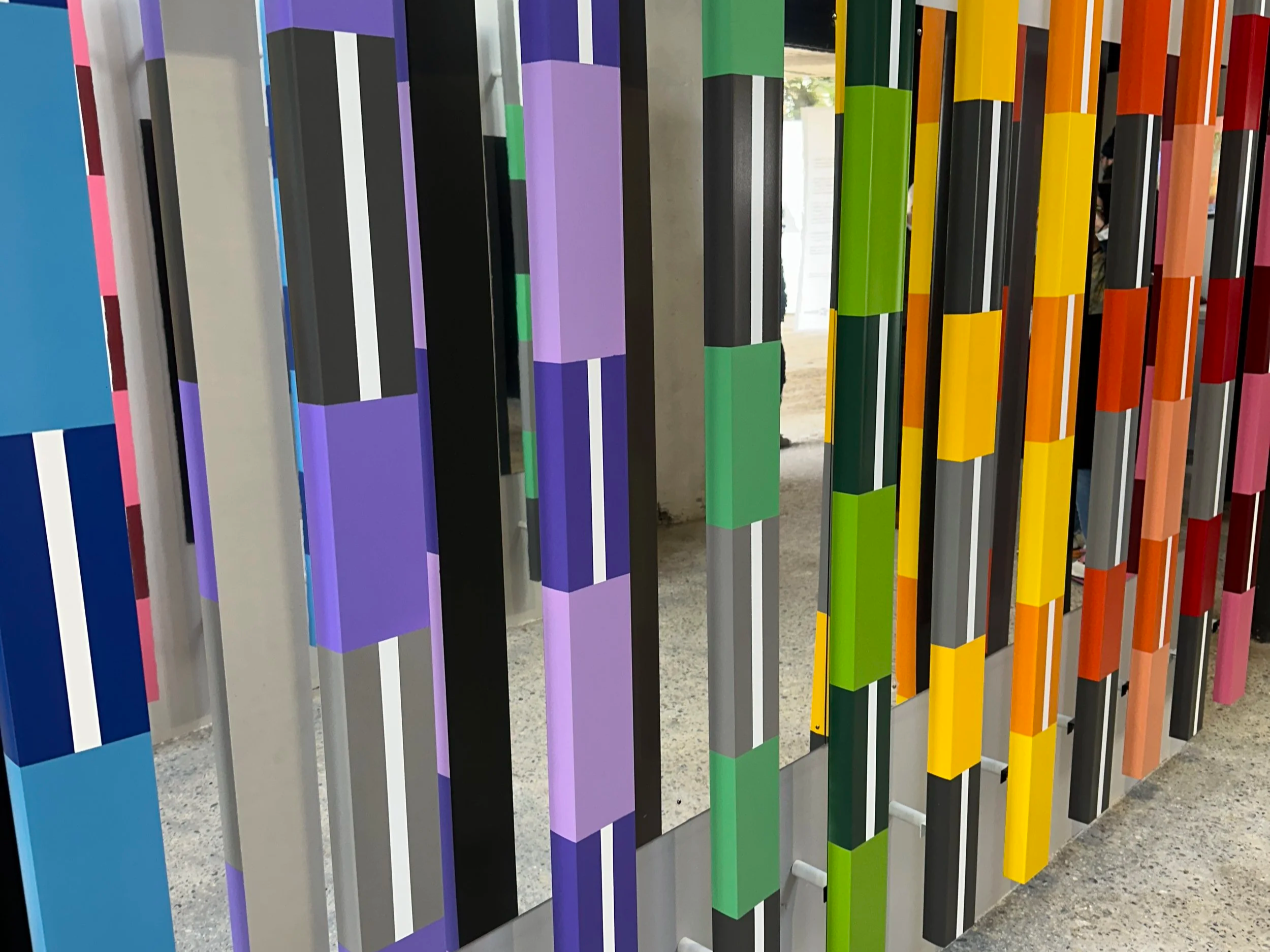
Juvenal Ravelo
Juvenal Ravelo: Colour, Community, and the Social Physics of Light
In a Venezuela Pavilion pulsing with chromatic energy, Venezuelan kinetic pioneer Juvenal Ravelo transforms colour into a social language. His interactive environment—comprising tubular light structures, flickering optical fields, and a public‑activated mural—invite visitors to co‑create the work.
Ravelo’s practice, rooted in Venezuelan community engagement, remains defiantly civic at a Biennale where identity often turns inward. His approach is the least autobiographical of this group: instead, he focuses on shared sensory experience, arguing that participation itself can be an act of cultural transformation.
Karimah Ashadu: Masculinity and Precarity on the Streets of Lagos
Winner of the Silver Lion, Karimah Ashadu’s film Machine Boys electrified audiences with its portrait of Lagos okada riders navigating life after the city’s motorcycle‑taxi ban.
Shot in intimate, sweat‑shimmering close‑ups, her riders oscillate between bravado and vulnerability, their machismo rendered fragile against the weight of political and economic precarity.
Installed in a purple‑lit chamber—part sanctuary, part street corner—the film was paired with Wreath, a brass tyre‑relief sculpture invoking both commemoration and a claim to legitimacy.
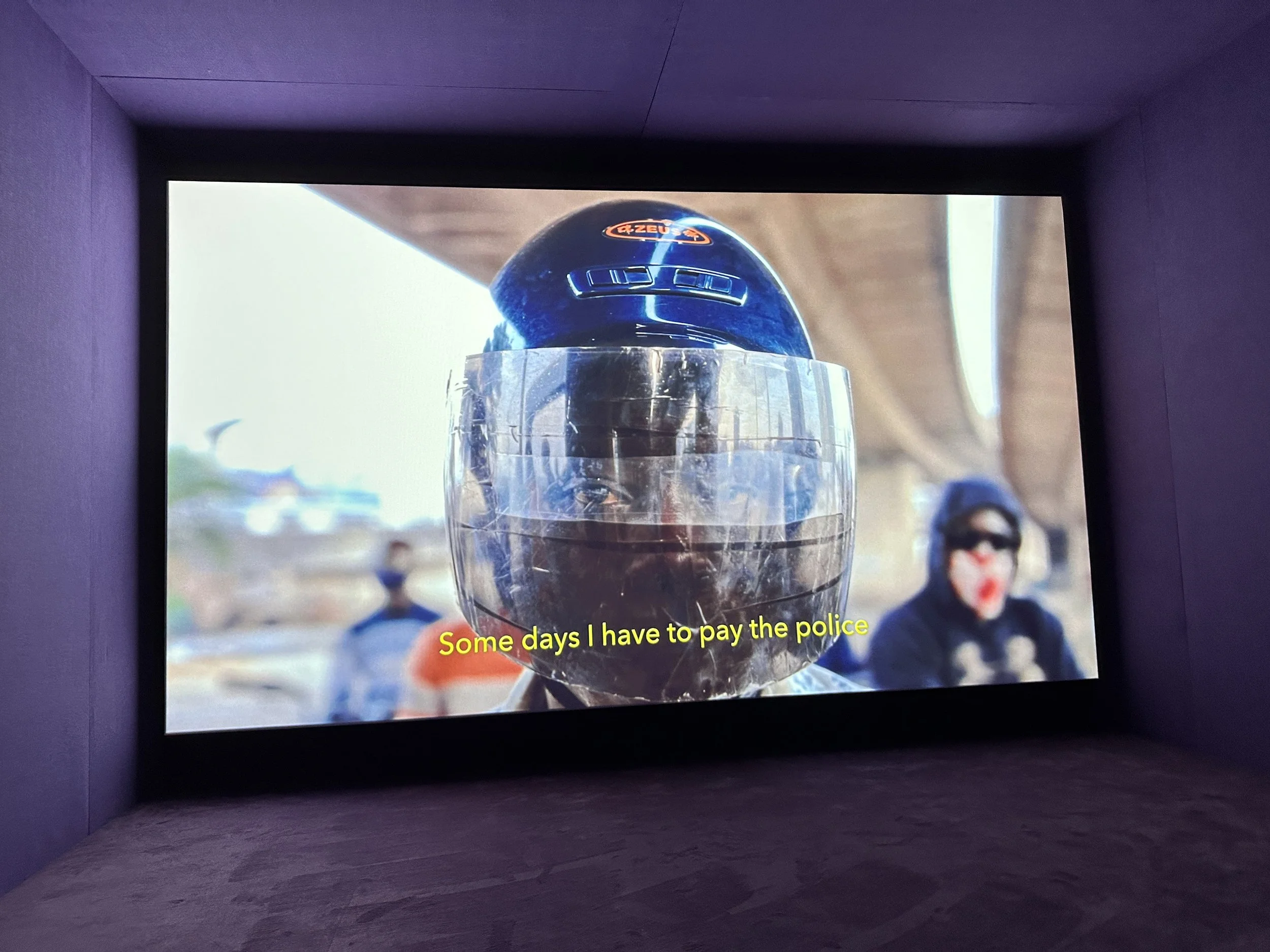
Karimah Ashadu, Machine Boys, installation view, Arsenale, Venice Biennale, 2024
Ashadu’s work sits at the Biennale’s sharpest documentary edge, examining how structural marginalisation shapes the performance of masculinity.
Santiago Yahuarcani: The Amazon Speaks Back
For Santiago Yahuarcani, a self-taught Uitoto painter from Pebas in the Peruvian Amazon, painting is a vessel for ancestral memory. His large llanchama works—like Aquí está caliente and El mundo del agua, bloom with plant spirits, jungle soundscapes and interwoven cosmologies.
Yahuarcani’s world is not symbolic; it is alive. His work asserts that climate catastrophe cannot be separated from the violent erasure of Indigenous knowledge systems. Here, the forest is not an ecosystem but a community: human, vegetal, spiritual and historical at once.
Among the six, his practice is the most cosmologically expansive - an anti‑colonial worldview rendered through mythopoetic clarity.
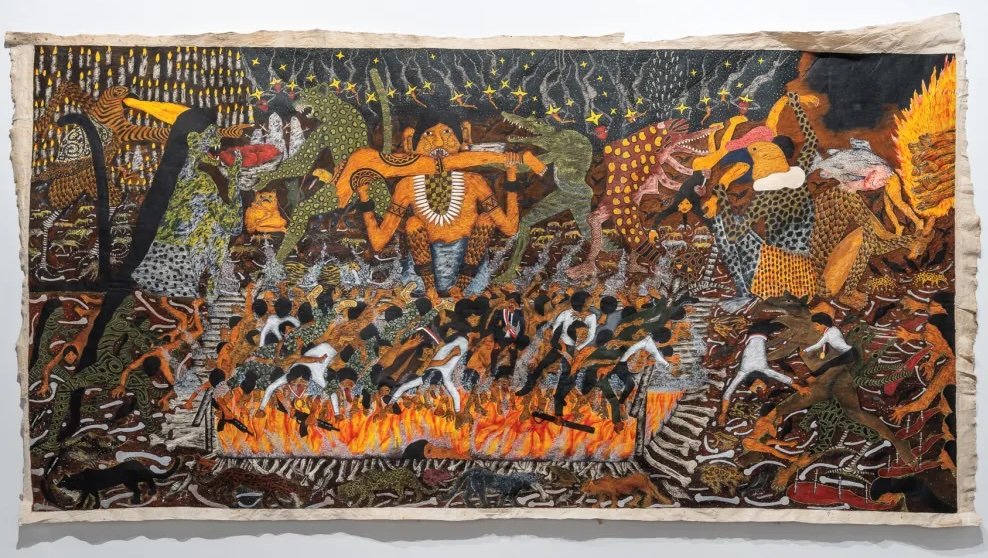
Santiago Yahuarcani
Ahmed Umar: Rituals of Memory and Queer Reclamation
Also in the Arsenale, Ahmed Umar’s performance‑based work Talitin (or Third), the body becomes an archive of cultural exclusion and reclamation. Drawing on a Sudanese bridal dance traditionally performed by women, Umar restages a ritual from which he was barred at puberty. See https://www.labiennale.org/en/art/2024/nucleo-contemporaneo/ahmed-umar
Adorned in jewellery and ceremonial costume, he uses gesture to confront familial memory, queer erasure, shame, and diaspora. The performance is deeply intimate yet culturally resonant: a choreography of belonging renegotiated.
Umar’s contribution stands as the Biennale’s most vulnerable and autobiographical offering, expanding discussions of tradition, gender, and the body.
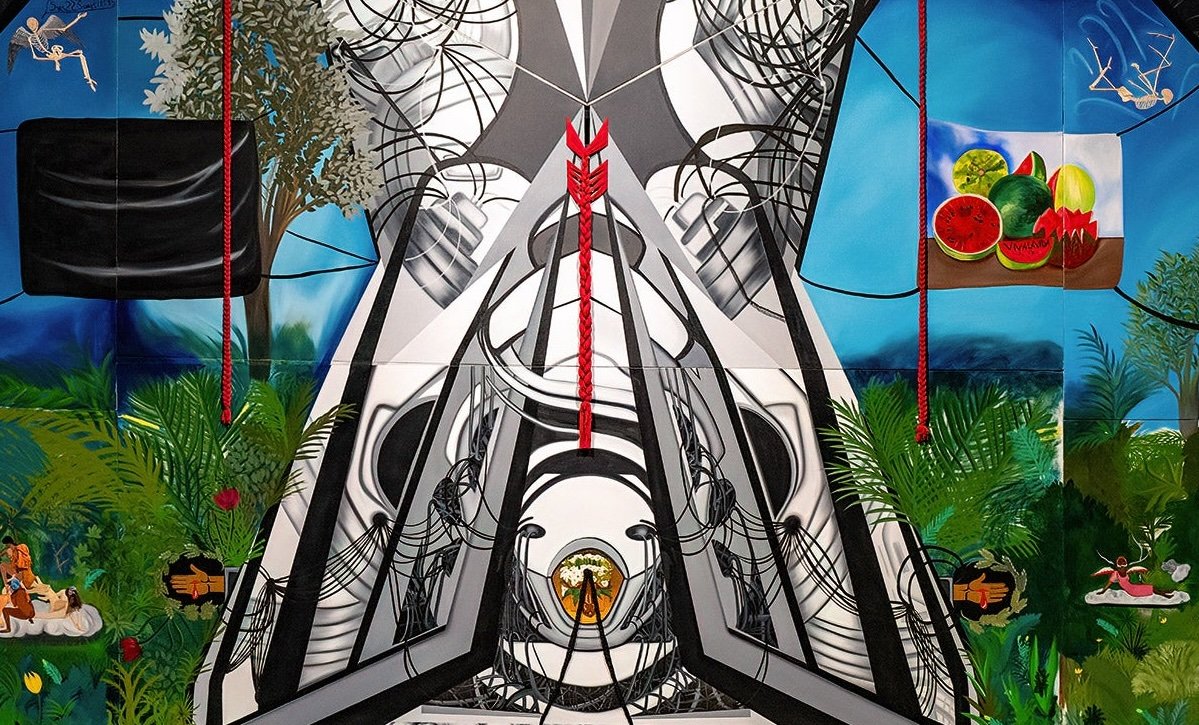
Frieda Toranzo Jaeger, Rage is a machine in times of senselessness (detail),
Frieda Toranzo Jaeger: Queer Futurisms in Embroidery and Oil
With her modular installation Rage is a machine in times of senselessness, Frieda Toranzo Jaeger delivers a lush, restless fusion of painting, embroidery, and queer world‑building. Her hybrid works reference Mexican muralism, the histories of Rivera and Frida Kahlo, fragments of Sappho, automotive design, and intimate queer mythologies. Cars become speculative vessels—feminine, post‑capitalist, defiantly non‑binary. Her oversized stitched signature parodies patriarchal authorship while reclaiming visual space for queer agency.
Toranzo Jaeger’s is the most materially hybrid practice here: a feverish, sensual imagining of alternative futures.
Jeffrey Gibson: A Monument of Indigenous Futurity
United States Pavilion
Marking a historic first as the sole Indigenous artist representing the U.S., Jeffrey Gibson transformed the American Pavilion into an immersive environment of unapologetic pattern, colour, and cultural synthesis. Text‑based works, multichannel videos, beaded and sculptural forms, and vividly patterned paintings reframes the building as a manifesto of Indigenous and queer futurity. Gibson blends Choctaw‑Cherokee traditions with pop culture, activism, and maximalist aesthetics to critique American identity while expanding it beyond narrow mythologies.
His pavilion stands among the Biennale’s most politically expansive statements—a celebration of multiplicity within a national platform often resistant to it.
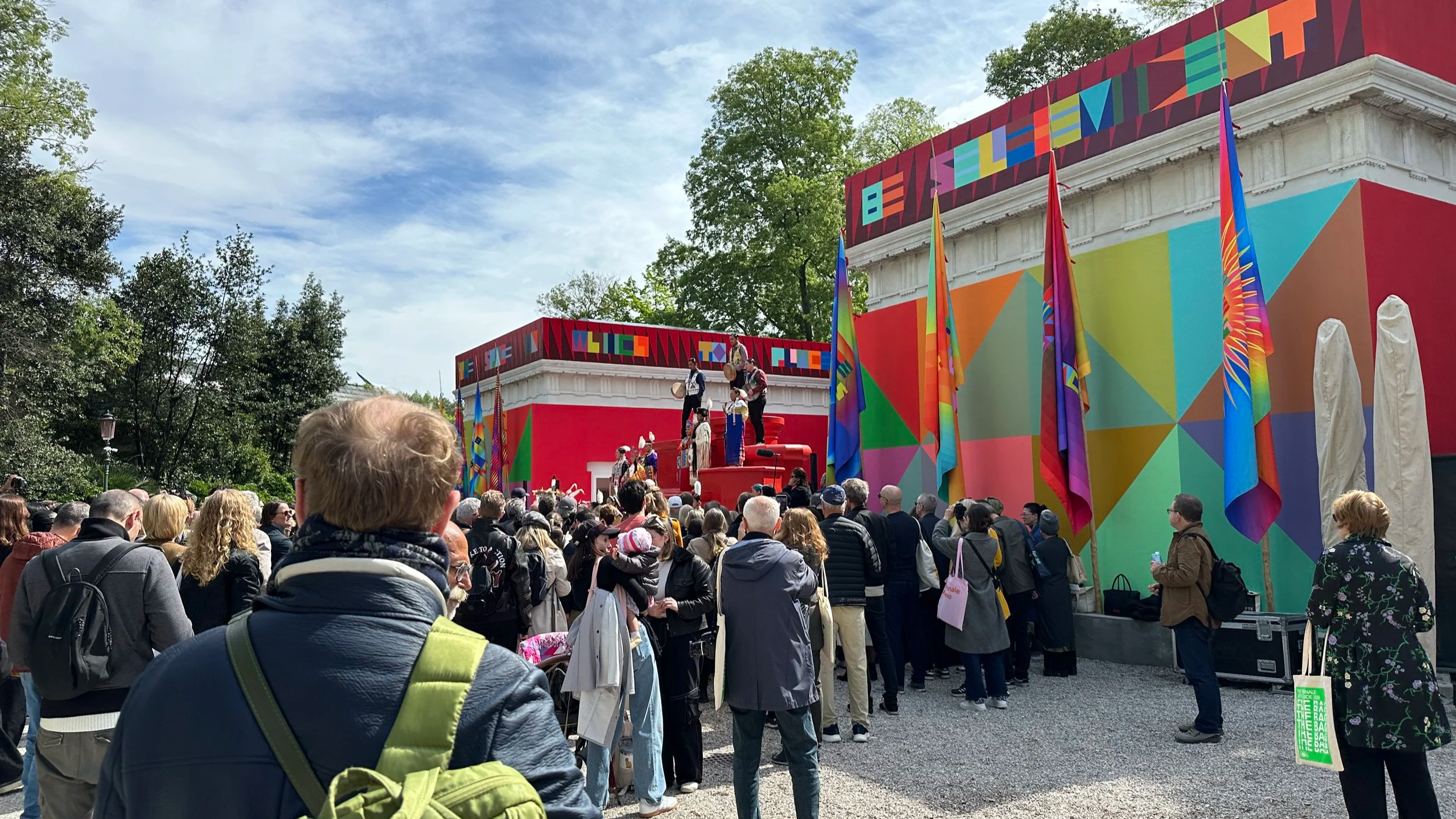
Jeffrey Gibson, performance, Venice Biennale, United States of America Pavilion, Giardini, Venice
Entangled Worlds: The Biennale’s New Cartography
Taken together, these six artists reshape the Biennale’s visual language in four key ways:
Reclaiming Suppressed Histories: Yahuarcani and Gibson centre Indigenous epistemologies while Umar confronts gendered erasure as Ashadu foregrounds marginalised labour. Each rewrites cultural narratives long pushed to the periphery.
Material Resistance: From Ravelo’s participatory colour structures to Toranzo Jaeger’s embroidered paintings and Gibson’s pattern‑driven installations, materiality becomes an act of political assertion.
The Body as Archive: Umar embodies ritual memory, Ashadu’s riders reveal masculinity under pressure, and Ravelo’s public mural invites collective embodiment.
World‑Building and Futurity: Whether through Amazonian cosmology, queer ecological speculation, or inclusive American futurism, these artists imagine alternative worlds rooted in care, complexity, and community.
In conclusion, the 2024 Venice Biennale demonstrates a decisive shift away from Western‑centric narratives toward a global multiplicity of voices. Ravelo reanimates kinetic abstraction; Ashadu exposes the fragility of labouring bodies; Yahuarcani safeguards cosmological sovereignty; Umar reclaims ritual; Toranzo Jaeger stitches queer mythologies into new futures; and Gibson remakes a national pavilion into a vision of Indigenous possibility.
Rather than one dominant story, this Biennale offers many—interwoven, resistant, and insistently alive.
Mark Segal, 2024